Trump Slams Canada Over “Golden Dome” Defence Plan, Warns Close China Ties Could Hurt Ottawa
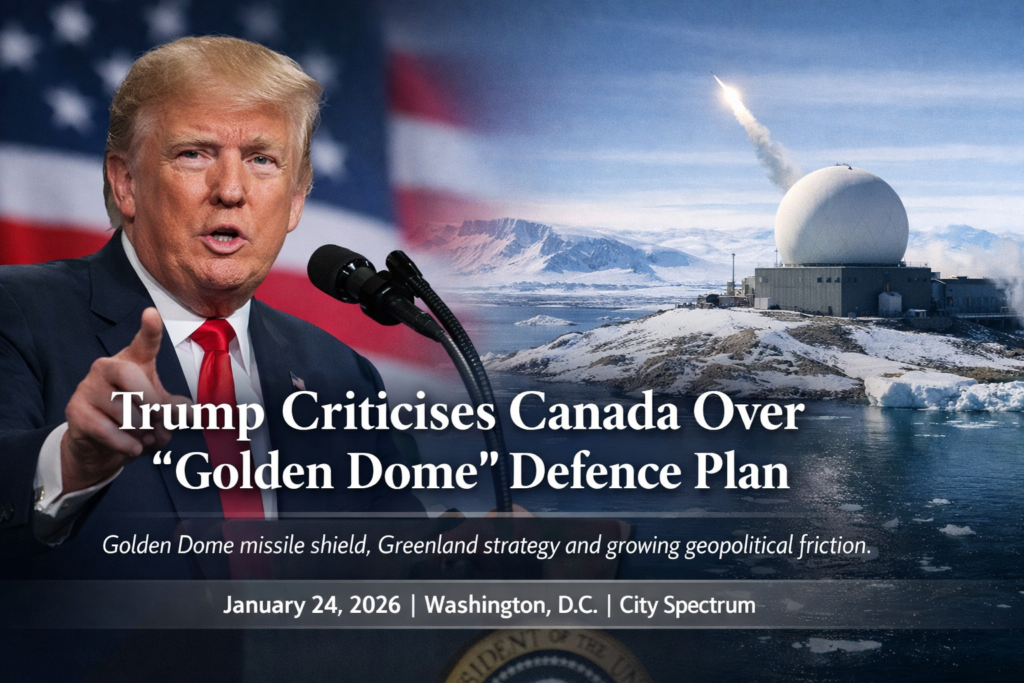
Trump reacts to Canada’s opposition to the Golden Dome system.
January 24, 2026 | Washington, D.C. | City Spectrum
In a dramatic escalation of diplomatic tensions between two long-standing allies, U.S. President Donald Trump has sharply criticised Canada for opposing his ambitious “Golden Dome” missile defence system — calling the decision a strategic miscalculation that could leave Canada vulnerable as it deepens economic ties with China.
Trump’s comments, posted on his social platform Truth Social, mark one of the most direct public confrontations between Washington and Ottawa in recent times. Trump accused Canadian leaders of rejecting a defence initiative that would bolster North American security, and instead favouring closer trade and business relations with Beijing — a choice the U.S. president claimed could “eat them up within the first year.”
What is the Golden Dome?
The Golden Dome is a U.S. proposed missile defence system — a high-tech shield designed to detect and intercept ballistic, hypersonic and cruise missiles before they reach their targets. It would consist of a constellation of satellites and ground-based systems intended to provide a near-global defensive layer, including protection across the Arctic region.
For Trump, Greenland — the vast Arctic island territory of Denmark — plays a central role in this plan because of its strategic position between North America, Russia and China. The president has repeatedly stressed the island’s importance for U.S. defence initiatives.
Canada’s Position and Trump’s Rebuke
Canada’s government has raised objections to the Golden Dome idea, particularly its implications for Arctic militarisation and sovereignty issues. Canadian leaders have also been pursuing expanded economic engagement with China, including recent trade initiatives, which Trump seized on in his criticism.
In his Truth Social message, Trump framed Canada’s stance as not only ungrateful but strategically unsound, arguing that rejecting a defence collaboration with the U.S. leaves Canada exposed at a time when global security threats are rising.
A Sharper Diplomatic Rift
The row gained further heat following remarks at the World Economic Forum in Davos by Canadian Prime Minister Mark Carney. While not naming Trump directly, Carney spoke critically about great-power competition and the erosion of the global rules-based order — comments widely interpreted as a response to U.S. pressure tactics.
Trump responded to Carney at Davos by asserting that Canada should be more appreciative of its security partnership with the U.S., saying Ottawa receives many “freebies” from Washington, including defence protections.
Carney, for his part, has defended Canada’s sovereignty and foreign policy choices, stating that Canada thrives because of its own values and decisions, not merely its alignment with U.S. strategic interests.
Why This Matters
This dispute highlights emerging friction within North American defence cooperation, even as Russia and China increase their influence in the Arctic — a region becoming more strategically significant due to shifting military postures and climate-driven access changes.
Analysts say the disagreement also reflects a broader geopolitical recalibration, in which countries like Canada are attempting to balance traditional alliances with economic engagement in Asia, particularly with China. Trump’s criticism underscores how defence, diplomacy, and trade are intertwining in new and often contentious ways.