India Approaches Global Heritage Authorities for Expansion of Punjab and Haryana High Court
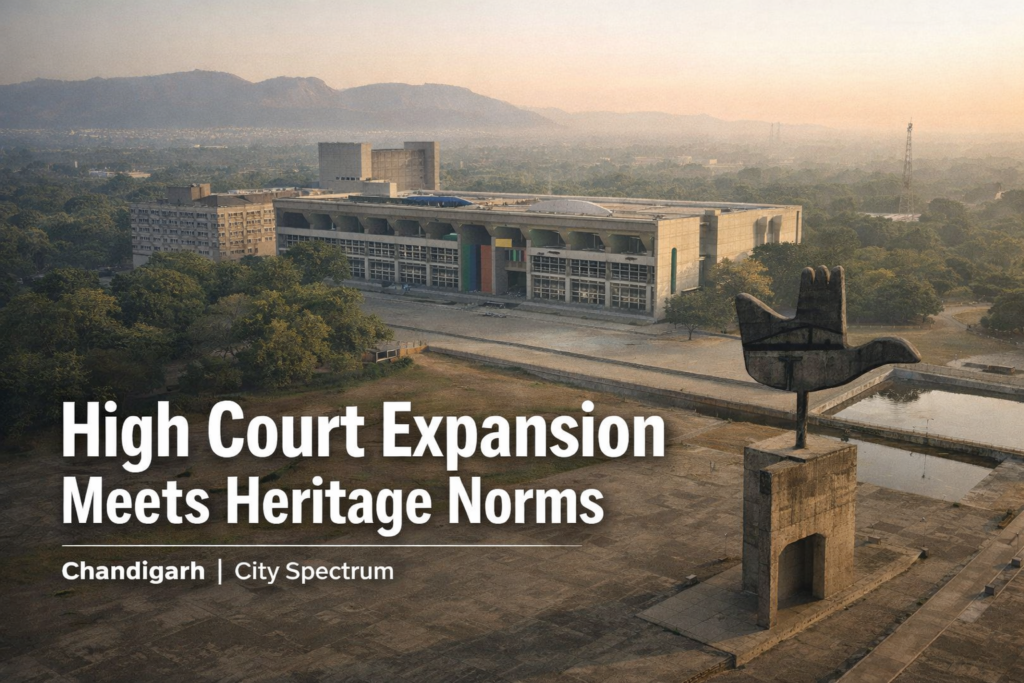
Proposed expansion of the Punjab and Haryana High Court in Chandigarh under global heritage review.
Chandigarh | January 24 | City Spectrum
The Government of India has formally initiated the international approval process for the long-planned expansion of the Punjab and Haryana High Court complex in Chandigarh, submitting a detailed proposal to global heritage authorities to ensure that judicial infrastructure growth does not compromise one of the world’s most significant modern architectural sites.
The proposal has been forwarded after receiving unanimous clearance from the Chandigarh Heritage Conservation Committee, which examined the plan through the lens of heritage preservation, architectural integrity, and functional necessity. The move marks a crucial step in balancing the growing demands of the justice system with India’s international commitments to heritage conservation.
A Court Within a World Heritage Site
The High Court building is a central component of the Chandigarh Capitol Complex, designed by legendary architect Le Corbusier. Recognised globally for its modernist vision, the Capitol Complex was inscribed on the UNESCO World Heritage List as part of The Architectural Work of Le Corbusier.
Due to this status, any new construction or expansion within the complex must strictly comply with international conservation norms. Domestic approvals alone are not sufficient; proposals are scrutinised at a global level to ensure the site’s Outstanding Universal Value remains intact.
Why Expansion Has Become Essential
Over the years, the Punjab and Haryana High Court has witnessed a sharp increase in litigation, judges, legal staff, and daily footfall. Existing infrastructure has struggled to cope with these demands. Several sanctioned courtrooms remain non-functional due to space constraints, while lawyers, litigants, and staff operate under mounting pressure in overcrowded conditions.
Officials acknowledge that the expansion is no longer optional but a necessity to maintain judicial efficiency, timely hearings, and administrative functionality.
Inside the Proposed Development Plan
The revised expansion blueprint focuses on scale without visual dominance. Key features include more than twenty lakh square feet of additional built-up area, forty new courtrooms to accommodate current and future judicial requirements, judicial chambers, registry offices, advocate facilities, and administrative blocks.
The plan also includes underground parking structures aimed at reducing surface congestion, along with support amenities such as legal service areas, record rooms, and essential utilities. Importantly, all new structures are proposed to be low-rise, visually subdued, and placed in a manner that does not interfere with the original spatial geometry conceived by Le Corbusier.
Heritage Safeguards at the Core
To maintain architectural harmony, the proposal follows strict guidelines laid down by international conservation frameworks. Inputs from heritage experts ensure compliance with principles endorsed by ICOMOS, the global advisory body on monuments and sites.
The design philosophy prioritises minimal visual intrusion, preservation of sightlines and open spaces, non-interference with original concrete forms and axes, and environment-sensitive construction methods. Officials have reiterated that no physical work will begin until all international approvals are formally granted.
International Review and Next Steps
The proposal has been sent to the Fondation Le Corbusier in Paris for expert evaluation before being placed before UNESCO’s World Heritage Committee. The plan will form part of India’s updated international management dossier, which is reviewed during UNESCO’s annual sessions.
Earlier development proposals within the Capitol Complex had faced objections and temporary suspensions, prompting authorities to revisit and refine the expansion strategy with greater sensitivity and global alignment.
A Test Case for Heritage-Sensitive Growth
The High Court expansion has now emerged as a national case study in managing growth within protected modern heritage sites. Chandigarh, envisioned as a living city rather than a static monument, continues to function as an administrative and judicial hub, making adaptive yet respectful development unavoidable.
The final decision by UNESCO will not only shape the future of judicial infrastructure in Chandigarh but could also influence how modernist heritage sites worldwide accommodate contemporary needs.
City Spectrum Insight:
The challenge before policymakers is not merely architectural, but philosophical — proving that progress and preservation can coexist without one erasing the other.